Tudor Fashion Trends: Historian Insights into Period Style
The Tudor period, spanning from 1485 to 1603, represents one of history’s most visually distinctive and opulent eras in fashion. This transformative age saw monarchs like Henry VIII and Elizabeth I reshape not just politics and religion, but the very fabric of European style. Tudor period fashion evolved dramatically across six reigns, reflecting shifting social hierarchies, international trade routes, and the personal whims of powerful rulers who understood that clothing communicated authority, wealth, and divine right.
Understanding Tudor fashion requires more than admiring the elaborate gowns and jeweled doublets—it demands recognizing how garments functioned as political statements, status symbols, and artistic expressions. The silhouettes, fabrics, colors, and accessories of this era tell stories of Renaissance innovation, courtly intrigue, and the emergence of England as a cultural force. Whether you’re a history enthusiast, fashion designer seeking inspiration, or someone interested in fashion style evolution, the Tudor period offers unparalleled insights into how dress shapes society.
The Evolution of Tudor Silhouettes
The Tudor period witnessed dramatic transformations in body silhouette, with fashion serving as a visual timeline of changing aesthetics and manufacturing capabilities. Early Tudor fashion, influenced by late Medieval styles, gradually shifted toward the distinctive shapes that define the era in popular imagination. The rectangular, blocky silhouettes of the 1480s-1490s gave way to more structured, geometric forms by the mid-sixteenth century.
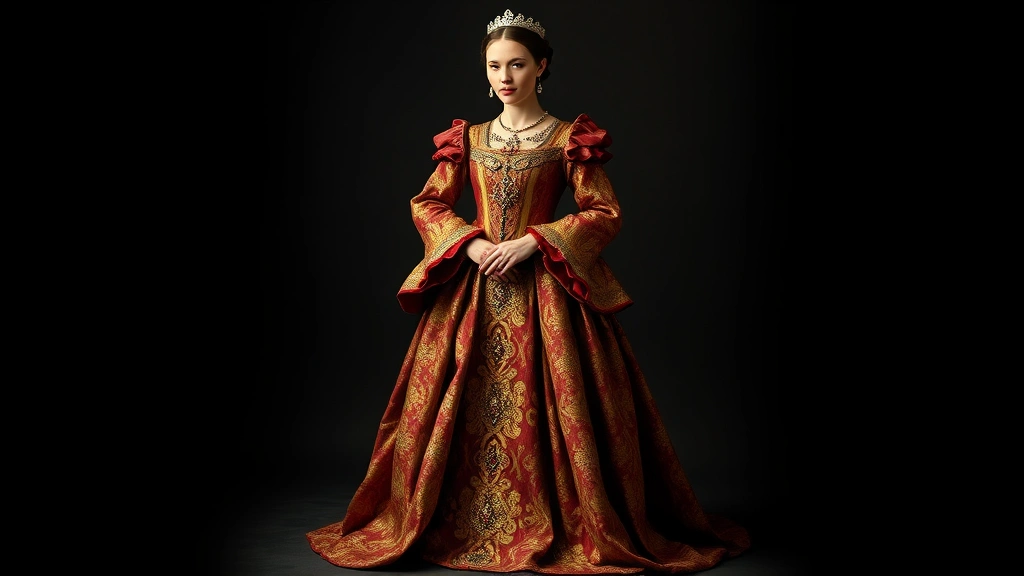
Women’s silhouettes underwent the most radical changes. The early Tudor gown featured a relatively natural waistline with a gathered skirt, but by the 1520s-1530s, the waistline had migrated upward toward the bust, creating an elongated, elegant line. The introduction of the farthingale—a framework of hoops constructed from wood, whale bone, or Spanish reed—revolutionized skirt construction entirely. This ingenious device allowed skirts to extend dramatically outward, creating the iconic bell-shaped silhouette that epitomizes the Elizabethan era. The farthingale transformed women’s fashion from practical to architectural, requiring doorways to be widened and furniture to be repositioned.
Men’s fashion evolved equally dramatically. Early Tudor doublets were relatively fitted but straightforward; by mid-century, they had developed pronounced peaking at the chest and featured elaborate slashing and puffing. The codpiece—a padded, often ornately decorated front panel—became increasingly prominent and exaggerated, particularly during Henry VIII’s reign. This peculiar garment functioned as both practical necessity and bold statement of masculine power. Hose transformed from simple leg coverings into separated upper and lower sections, with upper hose becoming increasingly voluminous and colorfully decorated.
Understanding these different fashion styles helps us appreciate how fashion types reflect their historical moments. The increasing complexity and exaggeration of silhouettes directly correlated with growing wealth, international trade, and the consolidation of power under strong monarchs.
Fabrics, Colors, and Luxurious Materials
The Tudor period represents a golden age of textile luxury, when international trade networks brought exotic materials to English courts. The fabrics used in Tudor fashion weren’t merely beautiful—they were statements of incredible wealth and access to global commerce. Silk, velvet, damask, and brocade dominated elite wardrobes, while linen served as the foundation for undergarments and chemises worn by all social classes.
Silk production had expanded dramatically by the sixteenth century, and Italian and Spanish silks became highly prized commodities in Tudor England. Venetian velvet, with its luxurious pile and rich colors, represented the height of luxury. Damask, a reversible patterned fabric featuring intricate floral or geometric designs, was favored for both garments and furnishings. Brocade, woven with gold and silver threads, appeared in the most formal courtly garments. These fabrics weren’t just expensive—they were often imported at great cost and represented direct connections to Mediterranean trade routes.
Color held immense significance in Tudor fashion, with certain hues restricted by law and social custom. Purple, achieved through Tyrian dye derived from murex shells, remained prohibitively expensive and was reserved for royalty. Scarlet, a vibrant red produced through complex dyeing processes, signified high status and wealth. Rich blues, created from indigo imported from the Levant, appeared in the most prestigious garments. Yellows and golds, symbolizing the sun and divine favor, were particularly favored by Henry VIII. Black, paradoxically, was both mourning wear and a mark of sophisticated elegance among the nobility.
The acquisition of these materials required participating in international trade networks that connected England to the Mediterranean, the Baltic, and eventually the New World. As England’s naval power grew under Tudor rule, access to exotic textiles expanded accordingly, making fashion both a reflection of and contributor to England’s rising global prominence.
Royal Dress Codes and Sumptuary Laws
The Tudor monarchs understood something fundamental about fashion that modern leaders often overlook: clothing functions as a system of social control and hierarchy enforcement. Sumptuary laws—regulations governing what different social classes could wear—reached their most elaborate and detailed during the Tudor period. These weren’t casual guidelines; they were legally enforceable statutes that protected the visual distinction between social ranks.
Henry VIII was particularly obsessed with regulating fashion. His sumptuary laws specified exactly what fabrics, colors, and garments different social classes could wear. Commoners couldn’t wear silk, velvet, or cloth of gold. Merchants and minor gentry had different restrictions than nobility. Only the royal family and those specifically granted permission could wear the most luxurious materials. These laws served multiple purposes: they maintained visible social hierarchy, protected domestic textile industries from excessive luxury consumption, and generated revenue through fines and licenses when nobles requested exceptions.
The enforcement of sumptuary laws reveals how seriously Tudor society took fashion as a system of meaning. Nobles who appeared in unauthorized garments faced fines and social censure. Yet paradoxically, the same monarchs who enforced these restrictions often granted exceptions to favored courtiers, creating an intricate dance of permission, restriction, and favor. Wearing a particular fabric or color could indicate royal approval or disgrace; a sudden change in a courtier’s dress might signal their rise or fall in the monarch’s estimation.
These regulations weren’t arbitrary—they reflected a worldview in which social order depended on visible, immediately recognizable distinctions. In an era before photography, newspapers, or instant communication, fashion served as the primary visual language through which people understood hierarchy and belonging. By controlling fashion, monarchs controlled the very language through which society understood itself.
Henry VIII’s Fashion Revolution
No discussion of Tudor period fashion can overlook Henry VIII, whose personal style preferences literally shaped the silhouettes and aesthetics of his entire era. Henry’s relationship with fashion transcended mere personal preference—his clothing choices became royal pronouncements that influenced everyone from nobility to merchants attempting to capitalize on courtly trends.
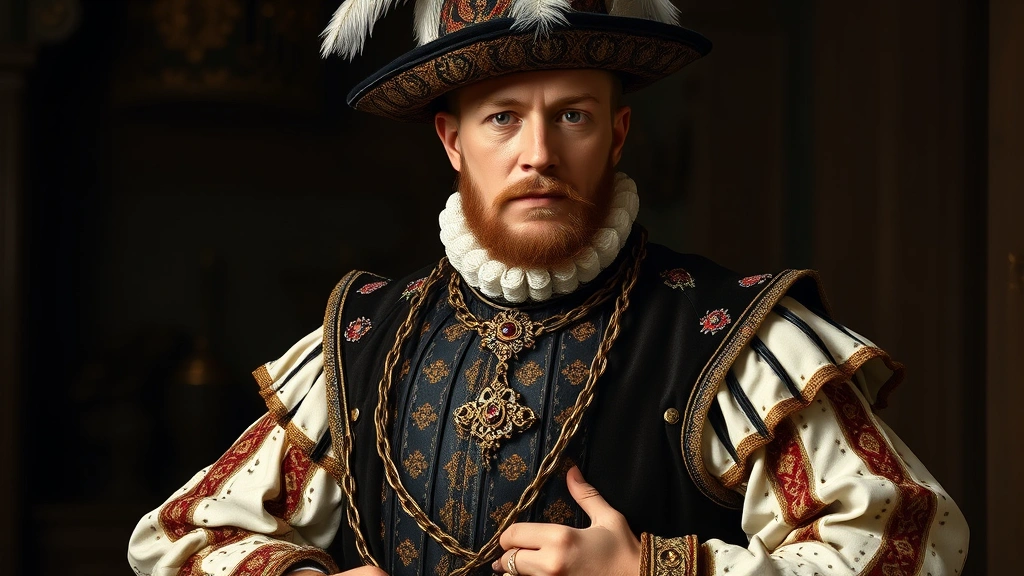
In his youth, Henry VIII was celebrated as a fashion innovator. Contemporary accounts describe him as handsome, athletic, and impeccably dressed. He favored bright colors, particularly golds and crimsons, and wore jewels with the confidence of someone secure in his power. His doublets featured elaborate embroidery, slashing, and puffing that displayed both wealth and the latest Continental fashions. He was particularly fond of feathered hats, jeweled chains, and ornate rings that advertised his position and refined taste.
As Henry aged and his body expanded, his fashion choices evolved strategically. The broad, heavily padded shoulders of his doublets created an impression of strength and authority, while the enormous codpiece—sometimes padded to shocking proportions—made bold statements about masculine power and virility. His famous portraits, painted by Hans Holbein the Younger, deliberately showcase a Henry VIII of imposing physical presence, legs splayed in a power stance, hands resting on hips. These portraits are, in many ways, fashion propaganda—carefully constructed images designed to communicate authority and control.
Henry’s marriages are often interpreted through the lens of his various queens, but fashion historians recognize that each marriage brought new aesthetic influences to the court. Catherine of Aragon brought Spanish fashion sensibilities; Anne Boleyn introduced French styles and more daring necklines; Jane Seymour’s simple elegance influenced court aesthetics during her brief reign. Henry’s romantic choices literally changed what was fashionable in England.
Understanding Henry VIII’s influence helps us recognize how fashion history timeline isn’t merely about garments—it’s about power, personality, and how individual leaders shape culture through their aesthetic choices.
Elizabeth I and Iconic Imagery
Where Henry VIII used fashion to project power and masculinity, Elizabeth I transformed fashion into an instrument of political genius. Elizabeth’s relationship with her own image and fashion was extraordinarily calculated and sophisticated. She recognized that as a female monarch in a patriarchal world, her appearance required constant strategic management. She became, in essence, a living artwork—a carefully constructed image designed to project authority, majesty, and political acumen.
Elizabeth’s famous portraits reveal a monarch who understood the power of fashion symbolism. The enormous farthingales that expanded her skirts created an almost architectural presence, literally taking up space and demanding attention. Her jewels weren’t mere decoration—they were political statements, often gifts from foreign dignitaries or symbols of England’s growing wealth and power. The famous “Ditchley portrait” shows Elizabeth standing astride a map of England itself, her skirts spreading across the nation like a protective force.
The Elizabethan silhouette became increasingly exaggerated as the reign progressed. Waistlines became impossibly narrow, achieved through rigid stays constructed from wood, bone, or metal. The contrast between the pinched waist and the enormous skirt created a visually striking—if physically uncomfortable—ideal of feminine beauty. Necklines dropped dramatically, exposing shoulders and décolletage in ways that would have been unthinkable earlier in the century. Yet Elizabeth herself often wore high necklines and long sleeves, maintaining a degree of modesty that conveyed authority rather than sexuality.
Elizabeth’s famous red hair—whether natural or achieved through elaborate wigs and dyes—became iconic. Her pale complexion, achieved through white lead-based cosmetics (which, horrifyingly, contained toxic mercury), became the standard of beauty throughout her reign. Her fashion choices weren’t personal whims; they were carefully orchestrated elements of a broader strategy to present herself as a monarch worthy of devotion and obedience. She understood that a female ruler required different visual strategies than a male one, and she deployed fashion brilliantly to navigate the contradiction of being a powerful woman in a male-dominated world.
Accessories and Jewelry
In the Tudor period, accessories and jewelry weren’t afterthoughts to complete an outfit—they were essential components of the fashion system, often more valuable than the garments themselves. Jewelry served as portable wealth, political messaging, and artistic expression simultaneously.
Rings were particularly significant, with Tudors wearing multiple rings on each finger. These weren’t mere decoration; they often contained hidden compartments for poisons, perfumes, or love letters. Rings could be gifts from monarchs, indicating favor and connection to power. The stones and metals used conveyed specific meanings: diamonds for constancy, rubies for passion and royalty, emeralds for fertility and hope. Elaborate signet rings bore family crests and were used to seal documents.
Necklaces and chains, often made from gold and studded with precious stones, hung in multiple strands down the front of garments. These chains were sometimes so heavy that they caused neck and shoulder pain, yet nobles wore them proudly as advertisements of wealth. Pearls held particular significance during Elizabeth I’s reign, appearing in jewelry, embroidered onto garments, and even woven into hair. The pearl’s association with purity and virginity made it especially symbolic for the Virgin Queen.
Brooches, often extraordinarily ornate and valuable, fastened garments and displayed artistic skill. Brooches depicting religious or mythological scenes functioned as miniature paintings in precious metals. Ornamental pins, sometimes called broaches or brooches, could be set with gems and cost the equivalent of small estates.
Headpieces and headdresses deserve particular attention as fashion statements. The French hood, a fashionable head covering that framed the face with a distinctive arch, was favored by Henry VIII’s later wives and remained popular throughout the period. The gable hood, with its distinctive peaked shape, appeared earlier in the reign. Men wore elaborate feathered hats, often adorned with jeweled bands and ostrich plumes. These headpieces weren’t merely decorative; they demonstrated wealth, fashionable awareness, and social status.
Gender-Specific Fashion Elements
While both men and women in the Tudor period wore elaborate, expensive clothing, the garments and their meanings differed significantly. Understanding these gender-specific elements reveals how fashion encoded assumptions about gender roles, sexuality, and power.
Women’s fashion emphasized fertility, modesty (at least in theory), and decorative beauty. The farthingale expanded the hips, visually emphasizing reproductive capacity. Stays and corsets cinched the waist to impossible dimensions, creating an hourglass silhouette that emphasized the difference between male and female bodies. Yet simultaneously, women’s fashion required enormous amounts of fabric and decoration, making women visually prominent and commanding attention through sheer material presence.
The evolution of women’s necklines tells its own story. Early Tudor fashion featured relatively modest necklines; by the 1540s-1550s, necklines dropped dramatically, exposing shoulders and the upper chest. This wasn’t universally approved—contemporary moralists railed against such immodesty. Yet among the nobility, these low necklines became standard, creating an interesting contradiction: women were simultaneously expected to be modest and chaste, yet their fashion literally exposed their bodies in ways that seemed to contradict that expectation.
Men’s fashion, by contrast, emphasized broad shoulders, a powerful chest, and, most notoriously, the codpiece. The codpiece evolved from practical necessity—a necessary front panel to men’s hose—into an increasingly exaggerated statement of masculine virility. Decorated with jewels, puffed and slashed, sometimes padded to shocking proportions, the codpiece was essentially a visual declaration of sexual power and masculine authority. That a garment so explicitly sexual could be worn in formal courtly settings reveals how differently Tudor society understood the relationship between clothing and sexuality.
Men wore hose in bright colors and elaborate patterns, often with different colors on each leg. Men’s doublets featured slashing and puffing that displayed the expensive linen worn underneath—a visual way of advertising wealth by literally cutting holes in expensive fabric to show off more expensive fabric beneath. This practice of slashing and puffing appeared on women’s sleeves as well, but was less pronounced and emphasized elegance rather than bold masculine display.
The Influence of Spanish Fashion
The Tudor period witnessed increasing Spanish influence on English fashion, particularly through the marriages of Henry VIII’s children and the complex political relationships between England and Spain. Spanish fashion was distinctive, formal, and increasingly influential throughout sixteenth-century Europe.
Catherine of Aragon brought Spanish fashion sensibilities to the English court in 1501. Spanish fashion emphasized structured silhouettes, high necklines, and rich fabrics in deep colors. The Spanish farthingale differed from the later French version—it was more rigid and extended further back, creating a shelf-like projection at the back of the hips rather than the bell-shaped expansion favored later. This Spanish version appeared in Henry VIII’s court and influenced early Tudor women’s fashion.
The relationship between Spanish and English fashion became increasingly complex as political tensions between the two nations escalated. Yet despite the religious and political conflicts that would eventually lead to the Spanish Armada, Spanish fashion continued to influence English style. Mary I’s marriage to Philip II of Spain brought intensified Spanish influence during her reign, while Elizabeth I, despite her conflicts with Spain, adopted certain Spanish fashion elements while simultaneously asserting her own distinct aesthetic.
Spanish black, a particularly deep and rich black achieved through complex dyeing processes, became fashionable in England during the later sixteenth century. Spanish ruffs—enormous starched collars that stood away from the neck—were adopted and eventually became even more exaggerated in England than in Spain. The stiffness required to maintain these architectural collars was achieved through starch, sometimes made from unusual sources; some accounts suggest that urine was used in the starch recipe, a fact that contemporary fashion commentators found either amusing or horrifying depending on their perspective.
The Spanish influence on fashion was part of broader cultural exchange. Spanish literature, art, and music all influenced England during the Tudor period. Yet as England developed its own distinct identity, fashion became a way to assert independence. Elizabeth I’s fashion choices, while incorporating Spanish influences, ultimately created a distinctly English aesthetic that reflected her nation’s emerging power and confidence.
FAQ
What materials were most commonly used in Tudor period fashion?
Silk, velvet, damask, and brocade dominated elite fashion, while linen served as the foundation for undergarments. Cotton was less common and more expensive than linen. Wool was used for warmer garments. The most luxurious garments combined multiple expensive materials—a single gown might feature silk brocade with velvet trim and gold-thread embroidery. When exploring fashion style history, understanding material choices reveals how economic and trade systems shaped aesthetics.
How did sumptuary laws affect everyday fashion?
Sumptuary laws created a strictly enforced visual hierarchy where social class determined what you could wear. Commoners couldn’t access the same fabrics, colors, or garment styles as nobility. These laws were legally enforceable and violations could result in significant fines. However, monarchs often granted exceptions to favored courtiers, making fashion a tool of royal favor. The laws ultimately protected luxury industries and maintained visible class distinctions in an era before modern systems of identification.
Why was the codpiece so exaggerated in Tudor men’s fashion?
The codpiece evolved from practical necessity into an exaggerated statement of masculine power and virility. As it became increasingly padded, decorated, and prominent, it functioned as a visual declaration of sexual potency and masculine authority. The codpiece represented a uniquely male fashion element that had no direct female equivalent, reflecting gendered assumptions about power and sexuality in Tudor society.
How did Elizabeth I use fashion as a political tool?
Elizabeth I transformed herself into a living artwork, using fashion to project authority and navigate the contradiction of being a female ruler in a patriarchal world. Her enormous skirts, jewels, and calculated image created an imposing presence. Her red hair and pale complexion became iconic symbols of her reign. Rather than emphasizing sexuality, her fashion choices emphasized majesty and authority, allowing her to command respect through carefully orchestrated visual strategy.
What colors were restricted to royalty in the Tudor period?
Purple, achieved through expensive Tyrian dye, was reserved for royalty. Scarlet red, created through complex dyeing processes, signified high status. Rich blues from imported indigo and golds symbolizing divine favor were also restricted to the elite. Black, while used for mourning, also represented sophisticated elegance among nobility. These color restrictions were enforced through sumptuary laws and reflected both the expense of achieving certain hues and the symbolic meanings associated with specific colors in Tudor society.
How did finding personal style work in the Tudor period?
Personal style in the Tudor period was constrained by sumptuary laws, social class, and the need to display appropriate status markers. However, within these constraints, individuals expressed preferences through jewelry choices, the quality of embroidery, and subtle variations in how they wore fashionable silhouettes. The wealthy could commission custom garments from skilled tailors, allowing for personalization within the bounds of fashion convention. Unlike modern personal style, Tudor fashion was fundamentally about communicating social position rather than individual expression.
What was the relationship between Tudor fashion and the Renaissance?
Tudor fashion was deeply influenced by Renaissance aesthetics, particularly through contact with Italian and Spanish fashion centers. The emphasis on rich materials, artistic embroidery, and elaborate jewelry reflected Renaissance values of beauty, craftsmanship, and display. However, English fashion gradually developed its own distinct character, particularly under Elizabeth I. The style loom daily blog covers how historical periods influence contemporary fashion understanding.